
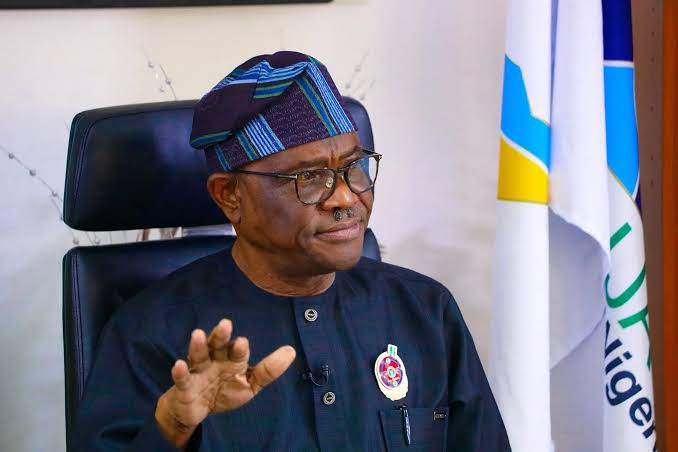
Federal Capital Territory Minister, Nyesom Wike, has defended the inclusion of individuals facing investigations in political campaign structures, arguing that an ongoing Economic and Financial Crimes Commission probe does not automatically prevent a person from participating in political activities or canvassing votes.
Wike made the position known on Wednesday during a media parley, where he questioned what he described as a double standard in the criticism surrounding the appointment of a person under EFCC investigation to President Bola Tinubu’s 2027 presidential campaign team. His comments were aired on Channels Television.
The controversy centres on former Minister of Humanitarian Affairs and Poverty Alleviation, Betta Edu, who was listed as Director of Women Mobilisation in the All Progressives Congress Presidential Campaign Council for Tinubu’s 2027 re-election campaign.
Edu was suspended by President Tinubu in January 2024 following allegations of financial impropriety and was subsequently investigated by the EFCC. She has not, however, been publicly convicted of any offence arising from the investigation.
Wike argued that being investigated by the anti-graft agency should not, by itself, be interpreted as a legal disqualification from political participation.
Wike questions criticism of campaign appointment
The former Rivers State governor challenged those questioning the moral justification of allowing a person under EFCC investigation to participate in a campaign council, asking whether an investigation should prevent such an individual from supporting a political candidate.
He pointed to instances where people facing criminal allegations had contested elections and eventually won, stressing that an allegation or investigation should not automatically be treated as proof of guilt.
Wike said there had been cases involving individuals who had been charged in court but still contested elections and emerged victorious. He did not identify the person he was referring to.
He went further by using a prisoner as an example, arguing that even someone serving a prison sentence could express support for a political candidate through another person.
According to him, a person visiting an inmate could receive a message from the prisoner asking him or her to support a particular candidate, meaning that the prisoner could, in that sense, canvass votes despite being incarcerated.
Wike also referred to an unnamed individual who had allegedly been linked to a coup plot but was still able to campaign for a political candidate. He questioned why a person being investigated by the EFCC should automatically be excluded from a campaign council when the investigation has not resulted in a conviction.
His position comes amid a wider debate over the standards that should apply to individuals selected for political appointments and campaign positions, particularly when such individuals are facing unresolved allegations by law-enforcement agencies.
Earlier, APC campaign council spokesperson Kemi Asekun-Shittu also defended Edu’s inclusion, saying she had not been found guilty of any offence and should not be expected to put her political life on hold indefinitely while waiting for the conclusion of an investigation.
Asekun-Shittu argued that the campaign council was an internal structure of the political party and that the APC had the discretion to select individuals it believed could contribute to its mobilisation efforts.
She also noted that the campaign council’s list was not necessarily final and could still be reviewed.
The controversy has nevertheless revived questions about the relationship between criminal investigations, political participation and public confidence in Nigeria’s electoral process.
While an EFCC investigation does not by itself establish guilt, critics of Edu’s appointment have questioned whether individuals facing unresolved allegations should occupy prominent positions in a presidential campaign organisation.
Wike, however, maintained that political participation should not be restricted solely because an individual is under investigation, particularly where there has been no conviction.
His comments have added a fresh dimension to the ongoing debate over the composition of Tinubu’s 2027 campaign team and the standard expected of politicians and political actors as parties begin preparations for the next general elections.
Leave a Reply