
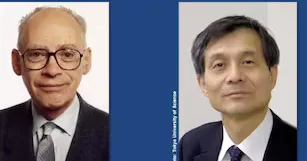
French chemist Henri B. Kagan and Japanese chemist Kenso Soai have been awarded the 2026 Nobel Prize in Chemistry for their discoveries of non-linear effects and autocatalysis in asymmetric organic synthesis.
The Royal Swedish Academy of Sciences announced the prize on X on Wednesday, recognizing the pair for solving a long-standing puzzle about how molecules can spontaneously favor one of two mirror-image forms.
Many essential molecules, including amino acids, exist as left- and right-handed versions. Living organisms almost exclusively use only one form, a property called homochirality. Kagan and Soai showed how this preference can emerge and be controlled in chemical reactions.
Kagan, a professor emeritus at Université Paris-Sud in France, demonstrated in 1986 that a small excess of one mirror-image catalyst can produce a much larger excess of the corresponding product a non-linear effect that gave chemists greater control over stereochemistry.
Soai, a professor emeritus at Tokyo University of Science, later developed an autocatalytic reaction in which the product itself drives the formation of more of the same mirror-image molecule, amplifying tiny imbalances until essentially one form dominates.
Heiner Linke, chair of the Nobel Committee for Chemistry, called their work “a solution to a chemical mystery that is over a century old” and described the reactions as “spectacular.” The findings have been especially important for the design of pharmaceuticals, where only one mirror-image version of a drug is usually desired.
The two scientists will share the prize of 12 million Swedish kronor.
Source; https://punchng.com/french-japanese-scientists-win-2026-nobel-prize-in-chemistry/
Leave a Reply