
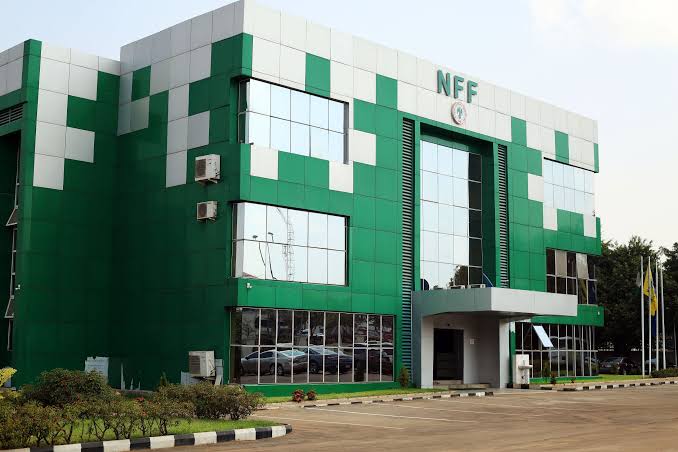
Nigeria’s football administration has entered a new phase following the resignation of the Ibrahim Gusau-led Nigeria Football Federation (NFF) board, with growing calls for accountability, professionalism and fundamental reforms across the game.
Gusau, NFF General Secretary Mohammed Sanusi and members of the federation’s executive committee stepped down after months of pressure over the country’s disappointing performances, financial accountability and concerns surrounding the administration of Nigerian football.
Gusau had previously maintained that his board would complete its four-year tenure and seek re-election at the forthcoming congress. However, announcing the resignation, he said the decision was taken in the overriding interest of Nigerian football and would create room for a comprehensive and orderly reform process.
He also defended the record of his administration, citing improvements in coaching education, including courses across various licence categories and the forthcoming CAF A-Licence course. He pointed to greater stability in the domestic league calendar, progress in refereeing and infrastructure projects such as the 68-room players’ hostel and training pitches at the MKO Abiola National Stadium.
Gusau also highlighted Nigeria’s silver and bronze medals at the last two Africa Cup of Nations tournaments and the Super Falcons’ 2025 Women’s Africa Cup of Nations triumph.
Results and finances under scrutiny
The NFF administration nevertheless faced growing criticism over the performance of Nigeria’s national teams.
The Super Eagles failed to qualify for the 2026 FIFA World Cup, while the Super Falcons missed the next Women’s World Cup. Nigeria’s U-20 men’s team also failed to qualify for the next Africa U-20 Cup of Nations.
Financial accountability has further complicated the situation. Anti-corruption agencies are examining the utilisation of a ₦17 billion Federal Government intervention fund approved for the NFF.
There have also been repeated complaints over unpaid allowances. The Super Eagles reportedly boycotted training in Morocco in 2025 over outstanding allowances, while members of the Flying Eagles later complained about unpaid qualification bonuses and camp allowances.
Who takes over?
With the NFF leadership gone, attention has shifted to the people who could help steer Nigerian football through the transition.
An emergency NFF congress is being considered, while the shake-up could also affect some state Football Association chairmen.
Names being discussed include former Lagos State Governor Babatunde Fashola, Remo Stars owner Kunle Soname, former NFF Secretary-General Musa Amadu and former National Sports Commission Director-General Patrick Ekeji.
Soname has reportedly been approached to head a reform committee but is said to be reluctant because of his commitments. Fashola has also reportedly been considered, although his schedule could make his involvement difficult.
The search has also renewed calls for football professionals with international experience to play a greater role in the administration of the game.
Former Super Eagles midfielder Seyi Olofinjana and former Chelsea football executive Michael Emenalo are among the professionals whose names have been mentioned.
Olofinjana has held several football management and scouting positions in Europe and possesses a UEFA Pro Licence, while Emenalo has played a major role in football development and administration, including his work with Chelsea and the Saudi Pro League.
Calls for accountability
Former players and football stakeholders have argued that the current moment should not be reduced to simply replacing the NFF president.
Former Super Eagles goalkeeper David Aigbovo called for wider changes within the federation, including a review of the technical department and the role of state FA chairmen.
Former Super Eagles player Paul Okoku also rejected arguments that calls for accountability could expose Nigeria to a FIFA ban.
He maintained that the fear of sanctions should not be used to prevent Nigerians from demanding transparency and competent leadership, especially as FIFA itself has faced questions over governance and accountability.
The debate has therefore shifted from who should occupy the NFF presidency to whether the entire system requires restructuring.
The problem goes beyond Gusau
One of the major concerns raised by critics is the NFF electoral structure.
The 36 state Football Associations and the Federal Capital Territory currently control 37 of the 54 votes in the NFF Congress, giving them about 68.5 per cent of the voting strength.
Critics say the concentration of voting power makes it difficult for alternative candidates and other football stakeholders to influence the leadership of the federation.
The structure was previously broader, with groups such as coaches, referees, players, school sports representatives, sports writers and academies having representation before changes were introduced.
Stakeholders have consequently argued that meaningful reform must include changes to the way football leadership is elected, rather than simply replacing one set of officials with another.
Ghana has been cited as an example, with its 124-member Congress providing representation to a wider range of football stakeholders.
President Tinubu orders overhaul
President Bola Tinubu has meanwhile directed a comprehensive overhaul of Nigerian football.
The President said the reform should address governance, administration, stakeholder representation, player-development pathways, domestic competitions and accountability.
He directed the Chairman of the National Sports Commission to work with the NFF Secretariat and relevant stakeholders to maintain essential football activities while developing a broad reform process.
The process is expected to involve consultations with football stakeholders as well as FIFA and the Confederation of African Football (CAF), ensuring that Nigeria’s reforms remain consistent with international football regulations.
Sports management expert Ebi Egbe welcomed the development, calling for an inclusive and professional football administration, credible elections, stronger grassroots development, better player and coach welfare, improved facilities and proper management of public funds.
For Nigerian football, the resignation of the NFF board may therefore represent more than a change in leadership.
It presents an opportunity to address the deeper problems that have affected the game for years from governance and elections to grassroots development, financial accountability, player welfare and international competitiveness.
Nigeria’s Football Reset Begins as NFF Board Steps DownNigeria’s Football Reset Begins as NFF Board Steps DownNigeria’s Football Reset Begins as NFF Board Steps DownNigeria’s Football Reset Begins as NFF Board Steps DownNigeria’s Football Reset Begins as NFF Board Steps DownThe real test will be whether the transition produces another change of personalities or delivers the structural reforms needed to place Nigerian football on a more professional and sustainable path.
Leave a Reply