
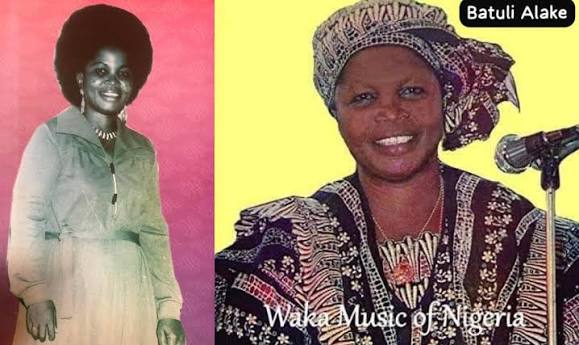
When discussing WAKA music, one name stands out above all others: Batile Alake. As a pioneering WAKA singer, bandleader, arranger, and composer, Batile Alake played a critical role in establishing the waka genre and left an indelible mark on the music scene before her passing on August 10, 2013.
She was not only a WAKA legend but also a figure of immense respect in the music community, renowned for her songs that seamlessly blended philosophy, melody, and irresistible dance rhythms. Her distinctive voice set the standard for younger waka singers, who often found themselves emulating her unmatched style. Simply put, Batile Alake is the creator of WAKA music. She spent her final days in her hometown of Ijebu Igbo.
Batile Alake, affectionately known by her numerous fans, was born on March 15, 1935, in Ijebu Igbo. She began her illustrious music career as an Alasalatu singer, rooted in the Islamic-influenced Asalatu style. Initially, her group performed waka music without any drums, but the subsequent introduction of Agidigbo, Akuba, and other instruments transformed her sound. Batile made history as the first waka artist to release a waka record, producing a series of singles before the emergence of long-play records. She recorded for labels like Decca and Leader Records, owned by Alhaji Lati Adepoju, who was also the former husband of Alhaja Abeni Salawa, and collaborated with a record dealer from “Oke Sopin.” Her songs never fail to evoke excitement in her listeners.
Batile’s husband, also a Juju musician and bandleader, passed away when their children were still very young, leaving her to raise and educate them on her own. Although she had to forgo her own education after losing her father at a tender age, she championed her children’s growth. Despite having two daughters and several male children who accompanied her to performances during her peak, none of her daughters pursued a music career. The essence of her early songs can be encapsulated in the lines:
🎵”E maa bami kalo, bo dile Olowo, ka rin gbere dele Oloro, mo dele Oloro oo.”
In those days, she would earn meagre amounts like Toro, Kobo, Epinni, and Onini. Any fan who sprayed a shilling was treated to an extended serenade, as a shilling held significant value at that time. Batile lived her entire life dedicated solely to waka music, never engaging in any other profession. She maintained a close relationship with Alhaji Haruna Ishola, the Apala legend also from Ijebu Igbo, and when Baba Gani released a record, Batile’s album was sure to follow closely behind.
A notable incident occurred after a television interview in the 70s; upon exiting the studio, she was greeted by a large crowd demanding a performance. In response, she sang for them until daybreak. Following a serious motor accident that nearly claimed her life while on her way to Lagos for musical instruments, she delivered a powerful song reflecting on her experience:
🎵”Awon Ota ti won rerajo, Ibanuje ti bawon Ota nile, awon Ota ti won rerajo. Ibanuje tibawon Ota nile, biwon ti ro tiwa si ninu ile, bee ni koje tiwon lojo gbogbo, awon Ota ti won rerajo, Ibanuje ti bawon Ota nile.”
Before each show, Batile would enjoy a bottle of Stout Guinness, and when asked about her musical preferences, Alhaji Sikiru Ayinde Barrister topped her list, along with Ayinla Kollington and Wasiu Ayinde. With her strong Ijebu dialect, she once impressed Fela Anikulapo at a concert, leading him to break protocol and shower her with Naira notes.
I gained insights about her life through a radiotelephone interview she conducted on June 12, 2012. In that discussion, I discovered that Late Kasumu Adio, another Apala singer from Ijebu Igbo who rivalled Alhaji Haruna Ishola, was primarily a drummer who hired a singer to perform while he played.
Despite her immense fame, Batile Alake never performed the Holy Pilgrimage to Mecca, as those who promised to sponsor her fell through, leaving her disappointed. Even a year before her passing, she expressed a strong desire to undertake the Hajj.
Batile’s last public appearance was at Chief Commander Ebenezer Obey’s 70th birthday celebration in 2012.
Batile Alake is undoubtedly among Nigeria’s foremost female singers. Her passing plunged me into shock and sadness, especially since just a day before her death, I had shared how her music reminded me of my late mother. For that reason, I listen to her songs almost daily, particularly when I need uplifting music to brighten my mood.
Leave a Reply