
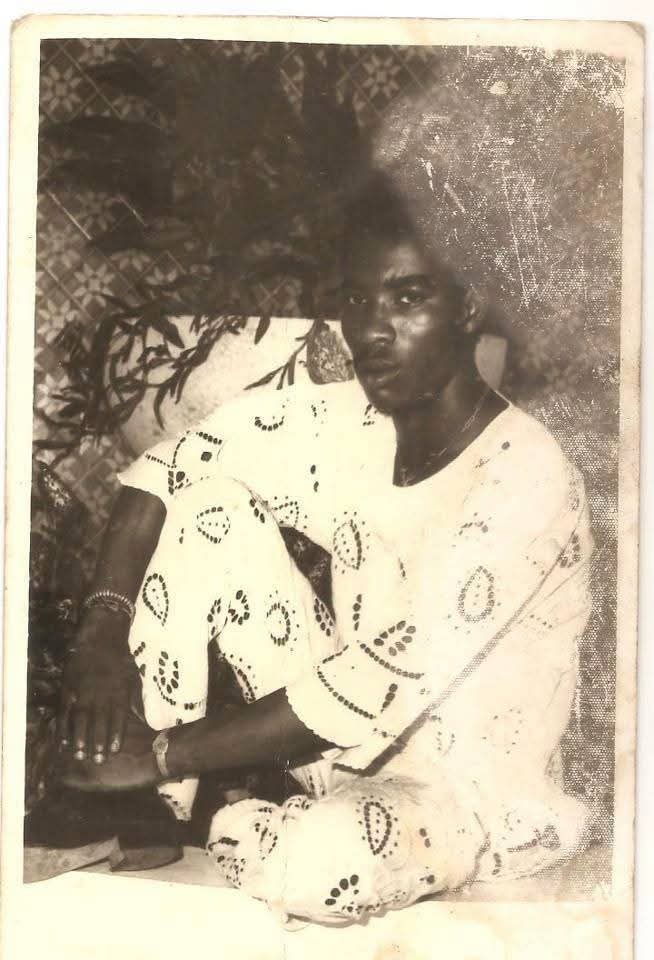
Before he became K1 De Ultimate, before the elaborate stage performances, international tours and the title of King of Fuji, Wasiu Ayinde was a young Lagos boy working behind the scenes for the man who would become his greatest musical mentor.
This photograph captures a much younger Wasiu Ayinde Marshal in the 1970s, during the early years of his association with the legendary Sikiru Ayinde Barrister.
Born 3 March 1957 in Agarawu on Lagos Island, Wasiu Ayinde grew up with an early interest in music. His passion eventually brought him into the orbit of Ayinde Barrister’s Supreme Fuji Commanders, where he initially worked as an instrument packer.
At that point, however, there was little indication that the young packer would eventually become one of the most influential figures in Nigerian music.
From Instrument Packer to Musician
Wasiu joined Ayinde Barrister’s group around the mid-1970s.
His initial responsibility was not to stand at the microphone. He was an instrument packer, one of the people responsible for handling and arranging the band’s equipment. According to biographical accounts, he later progressed to become a road manager.
But behind that apparently ordinary role was a young man who was absorbing everything.
He listened closely to the band’s compositions and performances. He learnt the repertoire and gradually began demonstrating that he possessed a musical instinct of his own.
The experience of working with Barrister proved decisive.
The relationship was not simply that of a young employee and an established musician. Barrister became his mentor, and Wasiu eventually adopted “Ayinde” into his professional name with his mentor’s permission and blessing.
It was during these years that the foundation for his own musical identity was laid.
The Young Man Who Was Watching and Learning
The 1970s were an important period in the evolution of Fuji music.

Ayinde Barrister had already established himself as one of the genre’s principal architects, and his Supreme Fuji Commanders were attracting audiences across Lagos and beyond.
For the young Wasiu, being around the band provided an informal education in performance, composition, stagecraft and the business of popular music.
He was learning not only how to sing, but how a successful band operated.
Eventually, he began experimenting with his own musical abilities, including performances connected with the older were tradition during Ramadan. This connection between Muslim devotional performance and the developing Fuji tradition was important to the musical culture from which both Barrister and Wasiu emerged.
By the end of the decade, the young apprentice was ready to establish an identity of his own.
The Birth of a New Wasiu Ayinde
Wasiu eventually left Barrister’s organisation and began building his own band.
His early professional identity included the name Wasiu Ayinde Barrister and His Talazo Fuji Commanders, and the term “Talazo” would eventually become inseparable from his musical revolution.
His first solo recordings appeared around 1980, with sources identifying Iba and Abode Mecca among his early releases. The exact dating of some early records varies between discographical sources, but the beginning of the 1980s clearly marked his transition from Barrister’s apprentice to an independent bandleader.
Then came 1984.
Talazo ’84 Changes Everything
If the 1970s were the apprenticeship, 1984 was the breakthrough.
Wasiu Ayinde released Talazo ’84, an album that transformed his profile and introduced a more expansive, energetic approach to Fuji.
The album’s success established what became known as the Talazo system, helping distinguish his music from the style of his mentor while remaining firmly rooted in the Fuji tradition.
His music became increasingly sophisticated.
Keyboards, saxophones, electric guitars and other Western instruments were incorporated into his arrangements, creating a fuller sound without abandoning the rhythmic foundation and vocal traditions of Fuji.
That willingness to experiment became one of the defining characteristics of his career.
He did not simply inherit Fuji.
He continually remodelled it.
The Man Behind the Early Records
An important part of Wasiu Ayinde’s early story is Saliu Akanmu Adetunji, the Ibadan businessman and music promoter who operated Omo Aje and later Baba Laje Records.
Adetunji had built a reputation as a record dealer, promoter and distributor before becoming the 41st Olubadan of Ibadan in 2016. His record business supported several Yoruba musicians, including the young Wasiu Ayinde.

Talazo ’84 was released on the Omo Aje label, and Adetunji’s support became an important part of Wasiu’s emergence as a major recording artist. Contemporary and retrospective accounts describe a long working relationship between the two men, with Adetunji’s label releasing numerous Wasiu Ayinde records.
For a young musician attempting to establish himself, having a record promoter and distributor willing to invest in his work was crucial.
From Barrister’s Apprentice to King of Fuji
The journey from instrument packer to Fuji superstar took only a few decades.
Wasiu Ayinde’s music expanded beyond the traditional boundaries of the genre. His performances became increasingly elaborate, his band grew in sophistication, and his audience expanded beyond Nigeria.
His international career included performances in Europe and North America, while his appearance at the WOMAD Festival in Reading in 1996 helped expose his music to a wider international audience. He was subsequently recognised as Best African Artist at the festival.
His honours multiplied.

Among them was the Olu Omo of Lagos title conferred by the late Oba Adeyinka Oyekan II, although published sources differ on the exact year, with some giving 1999 and others 2001.
Later came further traditional titles, awards and eventually national recognition.
But beneath the titles was still the same musical philosophy that had begun decades earlier: respect the tradition, but do not be afraid to change it.
Looking Back at the Young Wasiu
The young man in this photograph could not have known exactly where his journey would lead.
In the 1970s, he was simply a young musician learning under Sikiru Ayinde Barrister, carrying instruments, studying compositions and gradually discovering his own voice.
His mentor had created a musical foundation.
Wasiu would build upon it.
He would take Fuji into new sonic territories, introduce new instruments and production ideas, develop the Talazo style and eventually become one of the genre’s most recognisable international ambassadors.
That is what makes photographs from his early years particularly valuable.
They show Wasiu Ayinde before the crown, before K1, before the massive stages and before the legend fully emerged.
They show the apprentice.
And sometimes, history is most fascinating when it catches a future giant before anyone knows he is becoming one.
Photo credit: Soa Olaribigbe.
Sources
- The Nation, “Tribute to K1@60,” documenting Wasiu Ayinde’s birth, early association with Ayinde Barrister, Iba, Talazo ’84 and Saliu Adetunji’s record label.
- The Guardian Nigeria, profile of Wasiu Ayinde’s career, early role as an instrument packer, musical innovations and traditional honours.
- AllMusic, biography and discography of King Wasiu Ayinde Marshal, including Talazo ’84, musical innovations and international recognition.
- Radio Nigeria Ibadan, biographical account of Olubadan Saliu Adetunji and his role in promoting Wasiu Ayinde’s early recordings.
- Punch, obituary of Oba Saliu Adetunji and history of Baba Laje Records.
Leave a Reply