
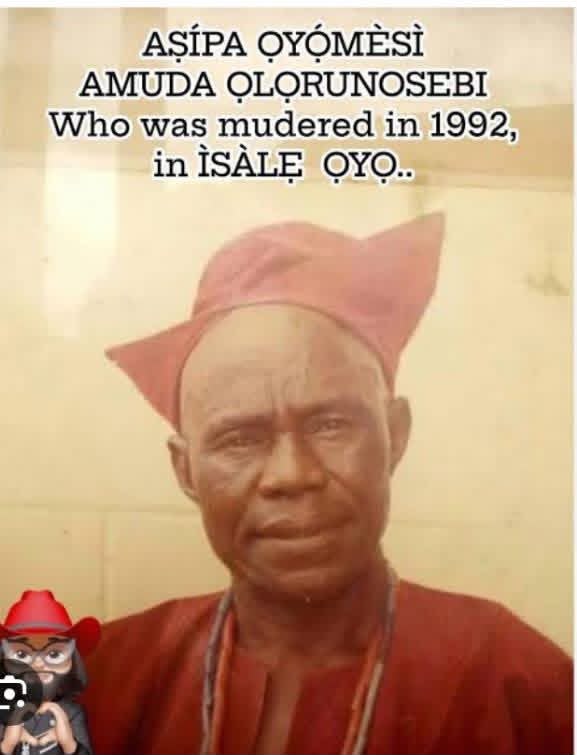
Late High Chief Amuda Okunade Olorunkosebi was a prominent traditional chief of Oyo and a respected member of the Oyo-Mesi. He was widely known as the Ashipa of Oyo, a position that placed him among the important traditional authorities and advisers within the ancient Oyo traditional institution.
Early Life and Education
Chief Amuda Olorunkosebi was born into the Olorunkosebi family of Oyo, a family whose history is closely associated with the indigenous community of Isale-Oyo and the traditional history of present-day Oyo town. Available accounts describe him as a man deeply conscious of his ancestry and the traditional heritage of his people.
He was educated in his early years, although the publicly available records consulted do not establish with certainty the name of the school or schools he attended. His later life demonstrated considerable business ability, leadership qualities and knowledge of community affairs.
Business Career
Before and alongside his traditional responsibilities, Chief Amuda was known as a successful businessman. He was associated with the transport business, through which he participated in the movement of people and goods and built relationships across Oyo and other parts of the country. He was also involved in the sale of fabrics and textiles, demonstrating the entrepreneurial versatility for which he was remembered.
His business activities helped establish him as a man of means and influence and provided him with a broad network of contacts outside the traditional institution.
Appointment as Ashipa of Oyo
Chief Amuda Olorunkosebi eventually rose to the prestigious position of Ashipa of Oyo. Family and community accounts place his appointment during the reign of Oba Lamidi Olayiwola Adeyemi III, with 1976 often cited as the year of his appointment.
As Ashipa, he became a member of the Oyo-Mesi and an important figure in the traditional administration of Oyo. His position required him to participate in traditional affairs and to advise on matters affecting the kingdom and its people.
His tenure, however, was not without controversy. His relationship with Alaafin Lamidi Adeyemi became increasingly strained. According to his son, Olaosegba, Chief Amuda was removed from the Ashipa position in 1978 and was later reinstated around 1981. The disagreements reportedly involved traditional authority, land and other matters concerning the powers and responsibilities of the Ashipa.
His Stand Against the Installation of MKO Abiola as Aare Ona Kakanfo
One of the most significant episodes in Chief Amuda’s public life was his opposition to the installation of Chief Moshood Kasimawo Olawale Abiola (MKO Abiola) as the Aare Ona Kakanfo of Yorubaland.
When Alaafin Lamidi Adeyemi moved to install Abiola to the historic title, Chief Amuda challenged the process through the courts. His position, according to accounts of the dispute, was that as Ashipa and a member of the Oyo-Mesi, he had a traditional role in matters concerning the installation of the Aare Ona Kakanfo and should not have been excluded from the process.
The dispute became a major legal and traditional confrontation. Contemporary accounts state that Chief Amuda’s lawyer was Chief Ajibola Lagunju, while Chief Afe Babalola represented the Alaafin. The litigation reached the courts immediately before Abiola’s installation. Despite the challenge, Abiola was eventually installed as Aare Ona Kakanfo.
The disagreement reflected wider questions about traditional authority and the respective positions of the Alaafin, the Oyo-Mesi and other Yoruba traditional institutions. Different accounts have offered different interpretations of the dispute, so allegations concerning the motives of the individuals involved should be treated with caution.
His Tragic Death
On 26 November 1992, tragedy struck. Chief Amuda Olorunkosebi was murdered at Ijawaya near Oyo. According to accounts given by his son, Olaosegba, he had been lured to the location before he was attacked. Reports described the killing as particularly brutal, including the twisting of his neck and the use of acid.
His murder generated enormous tension in Oyo and became the subject of a prolonged criminal and legal controversy. The family later petitioned the Oputa Panel, alleging failures and abuses in the handling of the investigation and prosecution. The matter also produced court proceedings, including the Supreme Court case involving Segun Oduneye. The available court record shows that Oduneye was convicted of conspiracy to murder but acquitted of the murder charge at trial.
It is important to distinguish these established legal proceedings from allegations that have been made over the years concerning other individuals. The family of Chief Amuda made allegations linking the circumstances of his death to the conflict surrounding the Alaafin, but those allegations should not be presented as established fact without qualification.
Seven Years Before Burial
Perhaps one of the most unusual aspects of Chief Amuda Olorunkosebi’s story was the length of time his remains remained unburied. Following his death in November 1992, his body was not buried for seven years, amid the continuing tension and controversy surrounding his death.
He was eventually buried in November 1999, seven years after his assassination. The prolonged period before his burial became an enduring symbol of the depth of the crisis that followed his death.
Legacy
Late High Chief Amuda Olorunkosebi remains a significant figure in the modern history of Oyo. He is remembered not only as the Ashipa of Oyo but also as a businessman, community leader and traditionalist who was prepared to challenge decisions he believed affected the rights and traditions of his people.
His life brought together commerce, traditional leadership, community advocacy and a major constitutional and cultural debate within Yoruba traditional politics. His opposition to the installation of MKO Abiola as Aare Ona Kakanfo, his prolonged disagreements with Alaafin Lamidi Adeyemi, his violent death and the extraordinary seven-year delay before his burial have all contributed to his enduring place in the history of Oyo.
Today, the memory of Chief Amuda Olorunkosebi continues to be invoked in discussions about the history of Isale-Oyo, the Ashipa institution, the origins and traditional ownership of parts of present-day Oyo town, and the relationship between the Ashipa and the Alaafin.
Leave a Reply