
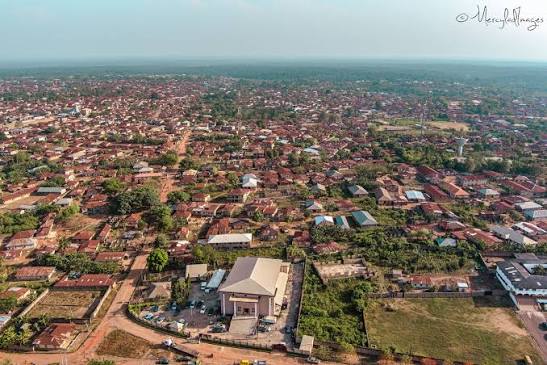
For a town like Gbongan, politics is more than election posters, campaign rallies and the competition for political offices. It is closely connected to the everyday realities of the people from the condition of roads and access to electricity to education, healthcare, economic opportunities and the expectations residents place on those who represent them.
Gbongan, the headquarters of Ayedaade Local Government Area of Osun State, occupies an important position within the state because of its location and connections to surrounding communities. Over the years, political decisions made at the state, federal and local levels have left visible marks on the town. Some have come through government infrastructure programmes, while others have emerged as constituency interventions by elected representatives.
The bigger question, however, is whether these interventions have fundamentally changed life in Gbongan or whether much more remains to be done.
When Politics Becomes Infrastructure
One of the clearest ways politics has affected Gbongan is through infrastructure.
Roads have remained a major issue because of the town’s strategic location and its role as a link between communities and major routes. Osun State’s infrastructure records include the rehabilitation of the Gbongan–Morakinyo Junction–Ife/Ibadan Expressway road, while earlier state plans also included the dualisation of the Gbongan–Akoda road. The state has similarly identified the Gbongan–Odeyinka–Orile Owu–Ajegunle corridor as an important route for connecting Osun with Ogun and improving movement towards Lagos.
Another major intervention was the Chief Bisi Akande Trumpet Bridge in Gbongan. When the bridge was completed, the Ayedaade Local Government described it as an infrastructure project that helped reduce accidents at the junction and opened up the town to increased economic and social activity.
These projects illustrate an important reality about politics: decisions made by governments can directly determine how easily people move, trade and connect with other communities.
For traders, farmers and transport operators, a good road is not simply a political achievement. It can mean reduced travel time, easier movement of agricultural produce and better access to markets. For residents, it can also determine how easily they reach schools, hospitals, workplaces and neighbouring towns.
But infrastructure also raises another question: how sustainable are political projects?
A road that is constructed but poorly maintained can gradually return to its former condition. A bridge can improve movement, but surrounding roads and drainage must also be maintained. This means that the impact of politics should not only be measured by the number of projects commissioned; it should also be measured by their quality, maintenance and long-term usefulness.
Representation, Education and the People’s Expectations
Politics has also found its way into education and youth development in Gbongan.
In 2025, Osun State’s public procurement records showed a contract for the renovation of existing structures at St. John’s AC Government Primary School, Isale Oja, Gbongan, with the project valued at more than N25 million. Another government contract covered the construction of a four-hole toilet facility at the same school.
At the federal constituency level, projects announced in 2024 by Hon. Lanre Oladebo, who represents the Ayedaade/Irewole/Isokan Federal Constituency, included a classroom project in Gbongan and road interventions across the constituency. Reports on the projects also listed solar streetlights, educational interventions and other constituency projects.
The political significance of such projects goes beyond the ceremonies that accompany their commissioning. For students, a renovated classroom or improved school facility can affect the environment in which they learn. For parents, it can influence confidence in public education. For communities, it becomes part of the tangible evidence used to judge whether elected representatives are delivering on their promises.
The same principle applies to healthcare.
Ayedaade’s network of primary healthcare facilities includes centres serving communities in and around Gbongan, while state health programmes have continued to target primary healthcare infrastructure across the local government.
Electricity has also featured in development interventions around the area. In 2015, the Osun State Government reported the rehabilitation of the Gbongan/Ikire 33KV feeder line as part of an effort to extend electricity towards communities including Araromi-Owu, Odeyinka and surrounding farm settlements.
All of these examples demonstrate that politics can produce real changes when public decisions are translated into functioning infrastructure and services.
But they also show why citizens must look beyond political slogans.
The Other Side of the Political Story
For residents, the real test of politics is not how impressive a campaign speech sounds. It is whether government programmes survive beyond the election cycle.
Gbongan’s experience reflects a broader challenge in Nigerian politics: projects can become associated with individual politicians or political parties, even though development is supposed to be a continuous responsibility of government.
This can make it difficult for citizens to distinguish between government responsibility, constituency projects, party promises and personal political initiatives.
That distinction matters.
A road financed through the state budget is different from a constituency project facilitated by a federal lawmaker. A project announced by a politician is also not necessarily the same as a project completed and functioning for residents.
Gbongan’s political story should therefore not be reduced to asking which politician has done the most. A more important question is whether the cumulative effect of different administrations and representatives has produced sustainable improvement in the lives of the people.
What Do Gbongan Residents Really Want?
Perhaps the most important part of the conversation is the voice of the people themselves.
Residents are ultimately less concerned about political labels than about results. They want roads that remain usable, electricity that is dependable, schools where children can learn properly, healthcare facilities that function, opportunities for young people and an economic environment where businesses can survive.
The political importance of Gbongan is therefore not simply about how many politicians come from the town or how many political meetings are held there. It is about whether political representation translates into development that ordinary people can feel.
The town’s electoral behaviour also demonstrates that politics remains competitive. In the 2026 Osun governorship election, results aggregated for Ayedaade showed a close contest between Ademola Adeleke and the APC, with the two leading candidates separated by only a handful of votes in the reported final figures. In the Otun-Olufi ward, for example, Adeleke recorded 2,154 votes against the APC’s 2,084.
Such results suggest that political loyalty cannot simply be taken for granted. Citizens can support parties and candidates while still expecting accountability from whoever eventually holds office.
And that may be one of the most significant ways politics shapes Gbongan: it gives residents the opportunity to decide who speaks for them, but it also places a responsibility on citizens to demand results after elections.
Beyond Election Seasons
The real impact of politics on Gbongan will ultimately be determined by what happens between elections.
A town does not develop because politicians visit during campaigns. It develops when public institutions work, projects are completed, infrastructure is maintained, businesses have an environment in which to grow and young people can see opportunities within their own communities.
Gbongan has benefited from various interventions in roads, bridges, education, electricity and other areas over different administrations. Official records and constituency reports provide evidence of several such projects.
Yet the existence of projects should not end the conversation. Their quality, accessibility, maintenance and actual impact on residents deserve continued scrutiny.
For Gbongan, therefore, the question “What has power really changed?” has no simple yes-or-no answer.
Politics has certainly changed parts of the town. It has brought infrastructure, opened opportunities and influenced the direction of development at different moments.
But the unfinished needs of the community show that political power is not an end in itself.
The ultimate measure is what remains after the campaign banners have disappeared: better roads, stronger institutions, functioning public services, economic opportunities and a better quality of life for the people of Gbongan.
That is where the real dividend of politics should be found.
Leave a Reply