
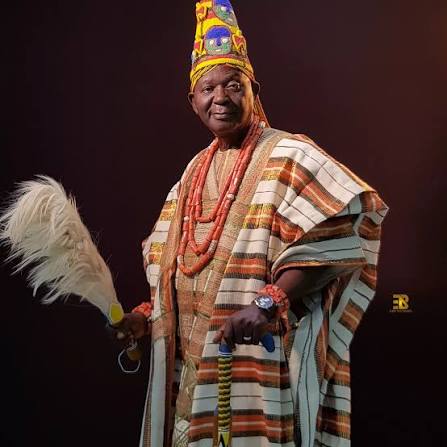
The story of Gbongan cannot be told without the institution of the Olufi, a traditional stool whose history stretches back to the old Oyo Empire and whose survival has been closely tied to the growth, displacement and rebuilding of the historic Yoruba town.
Today, the Olufi remains the traditional ruler of Gbongan, a major town in Ayedaade Local Government Area of Osun State. But behind the title is a centuries-old story involving royal lineage, migration, warfare, settlement and the preservation of Yoruba cultural memory.
The present monarch is His Royal Majesty Oba (Dr.) Adetoyese Oyeniyi Odugbemi I, the Olufi of Gbonganland, who has occupied the throne since 1998. His name and the institution he represents continue a royal tradition that Gbongan historical accounts trace to Olufioye, the figure from whom the title “Olufi” is derived.
According to the prevailing historical tradition, Olufioye was a son of Alaafin Abiodun Adegoriolu of Old Oyo, who reigned in the 18th century. One version of the tradition holds that Olufioye contested the Oyo throne but lost and subsequently left the old capital with followers. Another account links his departure to the political instability that followed Alaafin Abiodun’s death.
Whichever version is followed, the migration of Olufioye and his followers became a defining moment in the history of Gbongan. Historical accounts say the group moved through places including Igbori and Songbe before eventually establishing Gbongan-Ile, the old settlement of Gbongan.
The journey was not simply a movement of people. Tradition holds that Olufioye carried symbols of kingship from Oyo, including a beaded crown, helping to establish his authority as a ruler among the people who followed him.
This royal connection is important because it explains why the Olufi institution occupies such a prominent position in Gbongan’s identity. The town was not merely established as a settlement; it developed around a traditional authority whose history was connected to one of the most influential political centres in pre-colonial Yoruba history.
Gbongan-Ile, however, would eventually face one of the most difficult periods in its history.
In the early 19th century, warfare and insecurity associated with the political upheavals following the decline of the Old Oyo Empire affected several communities in the region. Historical accounts place a major attack on Gbongan-Ile around 1823, forcing the inhabitants to abandon the settlement and seek refuge in Ile-Ife.
The displacement did not destroy the Olufi institution.
Around 1825, the people of Gbongan rebuilt their community at a new location, in a more heavily forested area that offered greater security. The present Gbongan therefore emerged from a period of destruction and migration, with the Olufi stool remaining at the centre of the community’s traditional identity.
The rebuilding of Gbongan also left a remarkable cultural record in the form of its palace traditions.
A scholarly study published by the Journal of the Society of Architectural Historians explains that the oral history and oríkì orílẹ̀ of the Gbongan palace preserved information about the kingdom, its rulers, geography and architectural traditions. The study notes that after the destruction of Gbongan-Ile, these oral traditions helped guide the reconstruction of the palace and the kingdom at the new settlement.
That makes the Olufi palace more than a residence for a traditional ruler. It is part of Gbongan’s historical memory.
The palace’s history reflects the movement of people and cultures that shaped the town. Research on the architectural history of the palace notes the influence of Old Oyo traditions, while later settlement by people from Ile-Ife and Owu contributed additional cultural practices and festivals. The palace also incorporated spaces connected to traditional religious and cultural institutions.
The oríkì of the Olufi and the town therefore serves a purpose beyond praise. In Yoruba culture, oral poetry can preserve genealogies, historical events, places, achievements and collective memories. In Gbongan, scholars have described the palace’s oríkì orílẹ̀ as a kind of historical record in which the history of the kingdom and its rulers is intertwined with descriptions of the palace and its environment.
The Olufi Stool Through the Years
The modern history of the Olufi throne has passed through several reigns.
Historical records list Olatoye Fagbola as the first ruler of the present Gbongan, reigning from about 1825 to 1835. He was followed by Olujide, Sooko, Ajagbogbo, Asabi, Oyeniyi Makanju, Jacob Adeoye and Solomon Oyewole Babayemi before the emergence of the present monarch, Adetoyese Oyeniyi, in 1998.
The reign of Oba Solomon Oyewole Babayemi is particularly significant in the documentation of Gbongan’s history. He was not only a traditional ruler but also a scholar who documented aspects of the history and architecture of the Olufi palace. His work drew on oral traditions, praise poetry and knowledge preserved by palace drummers, priests, priestesses and other custodians of Gbongan’s cultural heritage.
His account illustrates how the traditional institution has served as a repository of knowledge. Historical information about past rulers, rituals, festivals, palace structures and the town itself was transmitted orally from generation to generation.
The present Olufi, Oba Adetoyese Oyeniyi Odugbemi I, has also maintained a visible role in community affairs. Over the years, the monarch has participated in matters involving education, community development, traditional leadership and the welfare of residents.
In one documented instance, the Olufi joined other traditional rulers in protesting prolonged electricity outages affecting communities in the area, highlighting the impact of poor power supply on businesses and residents.
He has also played a role in community educational affairs. During efforts surrounding Gbongan High School, the monarch was among stakeholders credited with supporting moves that helped the school retain its identity after an earlier reclassification and merger.
His palace has likewise remained a centre for the town’s traditional administration. In 2024, for example, the monarch announced the suspension of three chiefs, citing alleged misconduct, insubordination and actions he considered harmful to the unity of Gbongan. The development illustrated the continuing authority of the Olufi within the traditional chieftaincy structure of the town.
The Olufi’s influence has also extended beyond strictly traditional ceremonies. In 2022, Oba Adetoyese Oyeniyi received officials of the Joint Admissions and Matriculation Board and commended the organisation’s leadership, while the board acknowledged the monarch’s support and advice concerning its activities in his territory.
For many residents, however, the significance of the Olufi goes beyond individual interventions or palace decisions.
The monarch represents continuity.
Gbongan has changed dramatically from the settlement that emerged in the 19th century. The town has grown into the headquarters of Ayedaade Local Government Area and an important commercial and transportation centre in Osun State. Yet the title of Olufi remains one of the strongest symbols connecting modern Gbongan with its historical origins.
The institution has survived political changes, wars, migration and the transformation of Yoruba society. Its history reflects the ability of traditional institutions to adapt while preserving elements of older cultural structures.
For a town whose history is strongly connected to migration, the Olufi stool also represents the idea of a people carrying their identity with them. From the reported migration of Olufioye from Old Oyo, through the destruction of Gbongan-Ile and the rebuilding of the present town, the royal institution remained part of the community’s continuity.
Today, when the Olufi’s name is mentioned, it evokes not only the current occupant of the throne but a long line of rulers and the history of the people they represented.
That is ultimately what makes the Olufi of Gbonganland more than a traditional title.
It is an institution that connects Old Oyo to modern Gbongan, oral tradition to written history, the old palace to the present community, and generations of Gbongan people to a shared royal heritage.
As Gbongan continues to grow and face the realities of modern Nigeria, the Olufi institution remains one of the enduring symbols of where the town came from and an important part of the cultural identity it carries into the future.
Leave a Reply